
· June Merrick
Knitting With Stitch Markers: Every Placement, Decoded
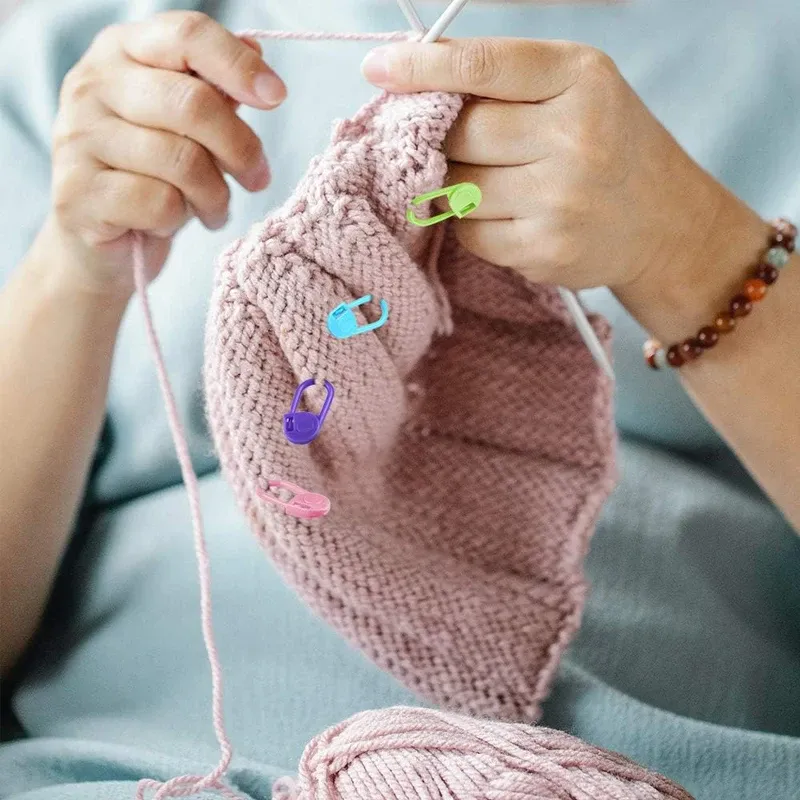
Patterns treat markers as if everyone already knows the moves. "Pm, work to end, sm on every following row" is a complete instruction, once you know where the marker goes and what happens when a decrease lands next to it. This guide is knitting only; crochet handles markers differently, and that has its own page on crochet stitch markers.
The three abbreviations that run every pattern
The Craft Yarn Council publishes the standard abbreviation list that English-language knitting patterns follow, and markers get exactly three entries in it. Learn them once and most of the mystery goes away.
| Written | Means | What your hands do |
|---|---|---|
| pm | Place marker | Put a marker on the right needle at the point you have reached |
| sm | Slip marker | Move it from the left needle to the right, working nothing |
| rm | Remove marker | Take it off the needle and put it back in the tin |
| pm A / pm B | Two named markers | Two colors, one job each, kept apart on purpose |
"Sl m" is the same instruction as sm. "Marker in place" means the pattern expects the one you set six rows ago to still be exactly where you left it.
A knitting marker lives between stitches, never on one
This is the single idea that makes patterns readable. When a pattern says "k12, pm, k12", the marker is not attached to stitch 12 or stitch 13. It hangs on the needle in the gap between them, and it keeps hanging in that gap for as long as the pattern needs the boundary. Work the twelve stitches, put the marker on the right needle, carry on.
The gap is the whole point: a boundary between two stitches cannot be miscounted, because the stitches on either side stay whatever they were. It is also why closed rings survive in a craft where clips do more, since a ring is faster to slip along a needle. The two styles sit side by side on our knitting stitch markers page.
Slipping the marker: the move nobody writes down
You reach the marker. It is sitting on the tip of the left needle with the next stitch behind it. Slip it across to the right needle exactly as it is, then work the next stitch. Nothing is knitted, nothing is counted, and the marker has moved up one row.
Two things go wrong here, and both are quiet. The first is knitting the stitch before you slip the marker across, which walks the boundary one stitch sideways every row. Ten rows later your raglan line leans and the cause is behind you. The second is the marker sliding off the needle tip while you are looking at the yarn, which is why a marker that locks shut is worth having on a needle at all: it can ride an open tip without leaving.
Increases and decreases either side of a marker
Shaping instructions read like code because they are positional. A raglan increase row runs something like "k to 1 st before marker, m1r, sm, k1, m1l" and repeats at all four markers. The marker never moves sideways; the fabric grows around it, and the seam line stays dead straight because a fixed reference point held it.
Watch for a yarn over landing right against a marker. The two occupy nearly the same space, and on slippery needles the marker can drop through the new loop. Slip the marker first, make the yarn over second, and the order settles it.
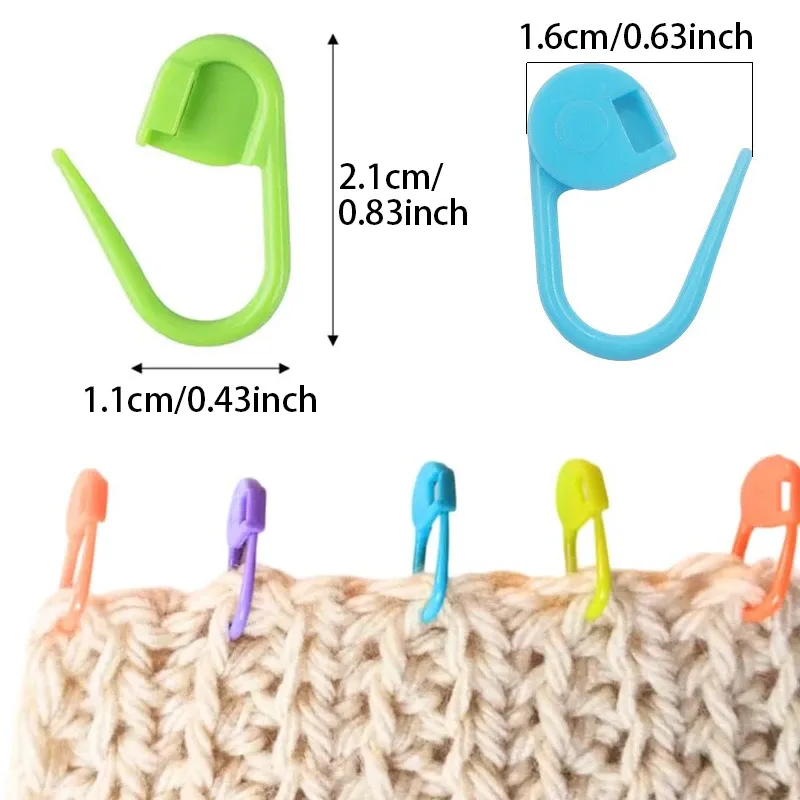
The second shaping job happens off the needle entirely. Clip a locking marker into the stitch you increased into and "increase every 6th row" becomes countable: five rows of clear fabric above the clip, then shape again. Ours measure 2.1 cm by 1.1 cm, small enough to sit in sock-weight fabric without pulling it out of shape.
Color-coding a top-down sweater
A top-down raglan has five markers in play before you have knitted a single row of body, and they do not all mean the same thing. Give each job its own color and the sweater reads itself.
| Job | Color rule | Style that suits it |
|---|---|---|
| Beginning of round | One color, used for nothing else, ever | Locking clip, so it survives a tip slip |
| Four raglan lines | All the same second color | Ring or clip, both fine on the needle |
| Sleeve separation points | A third color, placed on the setup round | Clip, so it can stay in the fabric later |
| Neckline shaping | Fourth color, removed once shaping ends | Clip, into the stitch itself |
| Right side of the work | Any spare color, clipped near the cast-on | Clip only, it never touches the needle |
The case for an assorted pack sits in that table: five jobs want five colors, and five identical markers cannot express any of it. The Purlclip 50-pack ships assorted for exactly this, and the enamel charm sets lock the same way if you want the round-start marker to be the pretty one.
Working in the round, on any needle
Anything worked in the round needs a marker at the start, because a tube has no edge to tell you where a round began. On a circular needle, the round-start marker rides between the last stitch of one round and the first of the next, and you slip it every single pass.
Double-pointed needles change the picture. The needle change already marks the round, so the marker does better clipped into the fabric a row down, where it cannot fall off a needle end. Magic loop sits in between: the cable gives you a landmark halfway, and the round start still wants its own reserved color.
When the marker stays and when it comes out
Markers on the needle stay for as long as the boundary exists, then the pattern says rm and they leave. Markers clipped into fabric are records, and a record is worth keeping until it has been read: leave the increase marker in until the sleeve is done and you can count the rows between shapings at a glance.
Take everything out before you wet block, so the piece relaxes flat with nothing pinching it. Slip them off as you go over the fabric and count them back into the tin. A marker left inside a finished sweater turns up eventually, usually in the wash.
Stocking the needle for a whole garment
Count the placements above and a single sweater is already asking for a dozen markers before the body starts. The arithmetic project by project, hat to blanket, is laid out in what are stitch markers, and the clasp-by-clasp comparison of what holds on a live needle is on the locking markers page.
Once the placements are automatic, the bookkeeping markers do not cover is rows, and that has its own tool: the on-needle row counter. If you also crochet, the four jobs both crafts share are in how to use stitch markers.