
Home › Crochet Stitch Markers
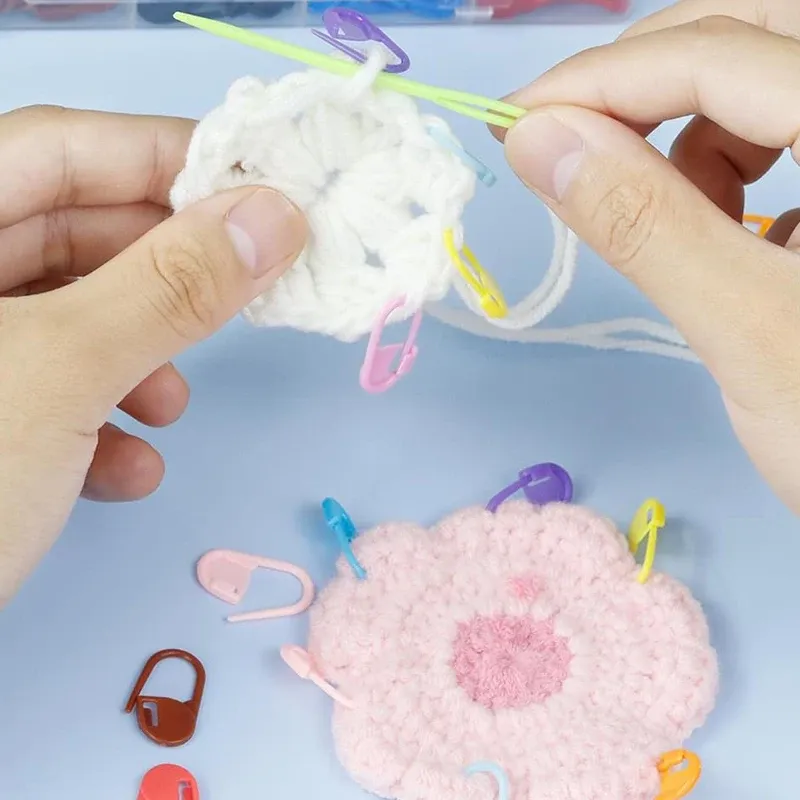
Crochet Stitch Markers That Actually Stay In
Crochet has no needle to park a ring on — so crochet markers have to clip in and lock. These do, 50 at a time, in colors you can spot from across the couch.
Why locking markers are the crochet marker
Knitting notions get designed first and crochet adapts — every crocheter knows the routine. Markers are the exception, because the locking style might as well have been invented for crochet. There is no adapting to do: clip, lock, keep going.
The jobs are everywhere once you look. Amigurumi is worked in a continuous spiral with no visible seam, so the only way to know where a round starts is the marker riding the first stitch. Filet and lace charts break into repeats you fence off with a marker at each boundary. Long foundation chains get a marker every 20 or 25 chains, because recounting 300 chains is how evenings die. And when you spot the right side of single crochet fabric — famously hard to tell from the wrong side — you clip a marker on it and stop squinting.
Then there is the job nothing else does: securing the live loop. A crochet project in a bag with an open working loop is one snag away from unraveling rows of work. Lock a marker through the loop before it goes in the bag and it physically cannot pull out. Buyers tell us this alone converted them from scrap-yarn loops.
If you also knit, nothing is wasted — the same 50 markers hang on needles and pin into stockinette just as well. Our knitting stitch markers page covers that side, and the main 50-pack page has the complete rating data and specs.
The four crochet marker placements worth memorizing
| Placement | How | When you need it |
|---|---|---|
| Round start | Clip in first stitch of the round, move up each pass | Amigurumi, hats, anything spiral |
| Repeat boundary | Clip at each end of the pattern repeat | Lace, filet, colorwork charts |
| Chain checkpoints | One marker per 20-25 chains | Blanket and wrap foundation chains |
| Working loop lock | Clip through the live loop, lock shut | Every time the project goes in a bag |
One habit tip: pick a color per placement and never change it. When the yellow marker always means "round start", your hands find it before your brain does. The assorted 50-pack exists exactly for that kind of color system — full details in our guide to how to use stitch markers.
Crochet runs on markers
Americans know how to knit, crochet or craft with yarn
— Craft Yarn Council, 2022
average across all 121 verified buyer ratings of this pack — zero below 4 stars
— Verified buyer ratings, complete export, 2026
markers needed to checkpoint a single 300-chain blanket foundation
— Purlclip placement guide, count above, 2026
Our test: we clipped one of these markers through the working loop of a cotton dishcloth project, locked it, and shook the project inside a tote bag for a full minute. The loop held and nothing unraveled. We repeated it with the loop left open and no marker: the work pulled out past the previous row almost immediately. It is a simple test, and it is the entire argument for locking your loop.
From verified buyers' own hooks
"I love them" (translated)
— Verified buyer
"They close well. Good purchase" (translated)
— Verified buyer
Photos from verified buyers. More on the reviews page.
Crochet marker questions
Why can’t crocheters use ring stitch markers?
Ring markers sit on a knitting needle between stitches. In crochet there is no needle holding live stitches — only one working loop on the hook — so a closed ring has nothing to sit on. It would have to be crocheted into the fabric permanently. Locking markers clip into a finished stitch and come out whenever you want.
Where do I place a stitch marker in crochet?
Clip it under both top loops of the stitch you want to mark — the V that sits on top of every crochet stitch. For marking rounds in amigurumi, place it in the first stitch of the round and move it up each time you pass. To secure your work, clip it directly through the working loop before storing.
Do these markers hold the working loop when I put my project down?
Yes — that is the single best reason crocheters carry locking markers. Slip the marker into the live loop, lock it, and the project cannot pull out in your bag. Verified buyers use them exactly this way on blankets and amigurumi alike.
How many markers do I need for a blanket chain?
Place one every 20 or 25 chains on a long foundation chain. A 300-chain blanket needs 12 to 15 markers, which is why small 10-packs run out fast. This pack has 50, so a full blanket setup still leaves you 35 spares.
Will they fit fine crochet thread?
The clip is slim enough to pass through stitches in fingering and lace weight yarn. On very fine doily thread, clip around the post of a stitch rather than through the top loops. Each marker weighs under a gram, so it will not distort fine work.
What is the difference with the enamel charm markers you sell?
Same locking principle, different finish. The enamel charm sets use gold lobster clasps with decorative charms — cats, daisies, starfish, shells — and cost more per marker. Most buyers keep a 50-pack like this one as their workhorse and a charm set for gifts and show projects.
Related: locking & removable markers · enamel charm sets · row counter · gifts for crocheters