
· June Merrick
Ring vs Locking Stitch Markers: Which to Use When
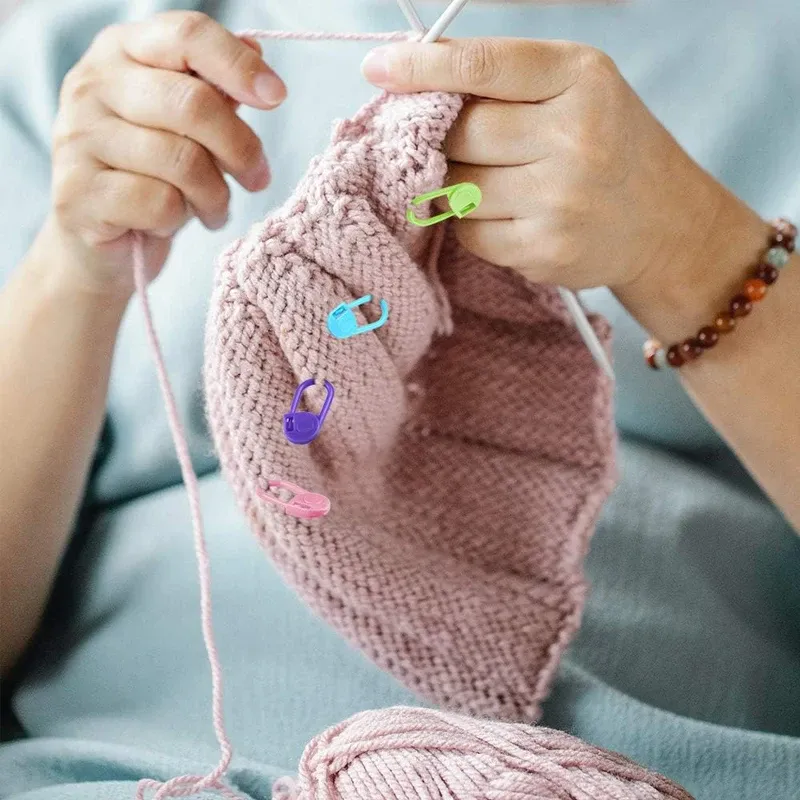
Every notions tin eventually holds both: smooth closed rings and clips that lock. In a product photo they read as two versions of one idea. In your hands they are different tools — one is a boundary that lives on a needle, the other is a pin that becomes part of the fabric — and most marker frustration traces back to asking one of them to do the other one's job.
This guide is the head-to-head. What markers are, style by style, is surveyed in what are stitch markers; the four placement jobs are walked through in how to use stitch markers. Neither settles the narrower question that decides what your hand actually reaches for: for the project on your lap right now, ring or locking? Here is the duel, situation by situation.
One marks a gap, the other marks a stitch
Strip the colors away and the two styles are two different physical ideas. A ring is a closed loop with no opening. The only place it can exist is threaded on a knitting needle, parked in the gap between two stitches. It belongs to neither stitch — it rides the needle, and each time you reach it you slip it from the left tip to the right and keep going. As a boundary it is close to perfect, because a gap cannot be miscounted: the stitches on either side of it stay exactly what they were.
A locking marker is a clip. It opens like a tiny pin, passes under the top loops of a finished stitch — or around a needle, or through a loose strand — and snaps shut into a catch. It attaches to a thing rather than to a position, and it stays attached until you deliberately flex it open. Every verdict in the rest of this article falls out of that one mechanical difference.
The case for the ring
Speed first. A ring has no moving parts and no decision attached to it. When a lace round has you slipping twelve markers every pass, rings pour from tip to tip in the same rhythm as the stitches around them. A locking clip can do the identical needle job locked shut — it is simply a half-second slower on the day you first place it, because you open and close it once.
Simplicity second. There is no clasp to check and no wrong way to put a ring on a needle. A seamless closed ring has no split edge and no coil, so a ply of laceweight has nothing to catch on — not on the way past, not after years in the tin.
Rings also match the native grammar of knitting patterns. "K12, pm, k12" was written with a ring in mind: place marker, slip marker, remove marker — all needle-side moves, all decoded in knitting with stitch markers, and a locked clip obeys every one of them identically. At typical US craft-retail prices the two styles sit a dime apart — roughly 20 cents a ring against about 30 cents for a molded locking clip (July 2026 retail ranges) — so the choice is never really about money. It is about which jobs exist on your project, and that is where the ring's list runs out.
Everything the ring cannot touch
The ring's entire territory is the needle. Slide the work off — to try a sweater on, to put a project into hibernation, to graft a toe — and the boundary information evaporates: the rings come away with the needle or roll under the sofa, and they take the record with them. A ring cannot mark fabric. And fabric is where most of a project's marking actually happens.
Consider what lives off the needle. The stitch you increased into, clipped so that "increase every 6th row" becomes countable instead of memorable. The right side of a stockinette or garter piece, flagged once near the cast-on so you never again read purl bumps in lamplight. Buttonhole positions on a cardigan band, decided while you can still change your mind. And the emergency: a dropped stitch is only an emergency while it can still run. A locked clip through the loose loop freezes the ladder on the spot; a ring can only watch from the needle, and a split ring can shake itself free in the project bag on the way home.
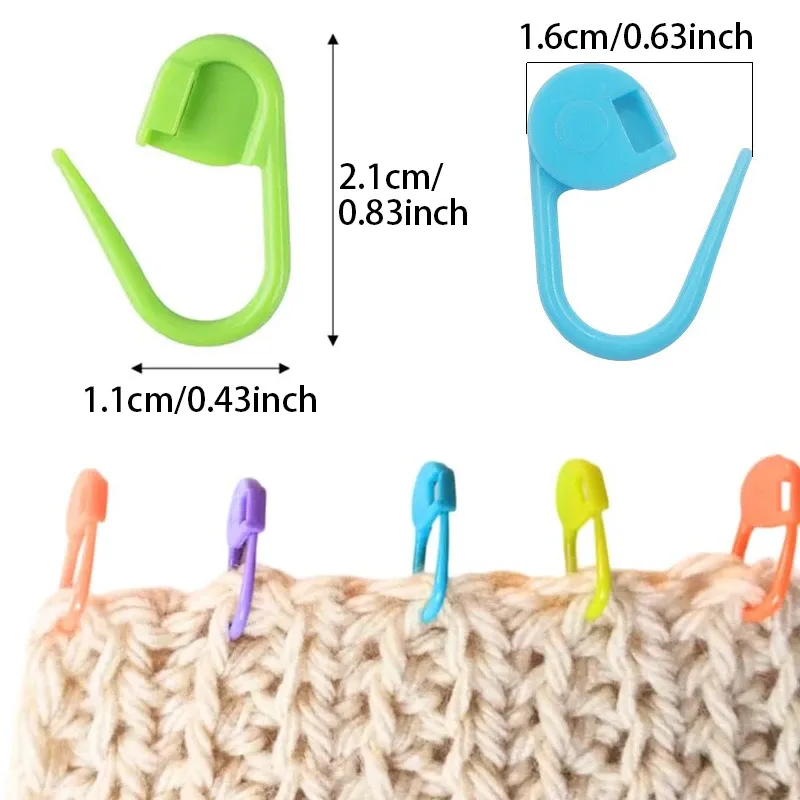
Each of those jobs takes a marker that opens, bites into the work and locks. Ours measure 2.1 cm by 1.1 cm and weigh under a gram, which is the difference between a record and a distortion when the fabric is sock-weight.
The duel on knitting needles
Knitting is the only arena where the two styles genuinely compete, so score it move by move. Round starts and repeat boundaries are ring territory by tradition, and the tradition has logic behind it: these markers get slipped hundreds of times per project, and the ring's zero-friction slip is felt on every single pass. If your knitting is hats, yokes and shawls worked end to end on one circular needle, a set of rings parked on the cable is the classic setup, and nothing about it is wrong.
The clip answers with security. A ring sitting near a needle tip can slide off while you are looking at the yarn — the quiet failure you discover a row later, when the boundary you trusted is gone. A locked clip rides an open tip without leaving, which changes the calculus on double-pointed needles, on magic loop, and on any project that commutes in a bag. Same needle job, but only one of the two styles survives the trip.
Fit is the tiebreak nobody mentions. A ring is bought to match a needle: roomy enough to slide freely, snug enough not to flop, which is why ring sets come graded in sizes and a shawl needle and a bulky-blanket needle want different rings. A clip does not care. Locked shut, its opening rides standard needles across the common sweater and blanket range, and on the very largest needles it simply clips into the stitch below the tip instead, marking the same column of stitches. One style asks you to plan ahead; the other adapts on the spot.
The deciding fact, though, is the asymmetry. A locking marker does the ring's job the moment you snap it shut; a ring does not do the clip's job under any circumstances. On the raglan sweater we counted mid-sleeve-split — fourteen markers in play at once, July 2026 — at least half were clipped into fabric where no ring can follow. Knitters rarely choose between the styles so much as discover the ratio their projects impose.
In crochet, the duel is a forfeit
Crochet never signed up for the fight. The craft keeps exactly one loop live on the hook; everything behind it is finished fabric. A closed ring has nothing to sit on — no needle, no gap, no live row — so the only way to get a ring into crochet is to crochet it in permanently, which makes it a decoration, not a marker. Every crochet marking job goes to the style that opens and locks, by walkover.
And crochet is the more demanding client of the two. Amigurumi worked in a spiral has no seam at all, so the clip riding the first stitch of the round is the only record that rounds exist. A long foundation chain gets a checkpoint clip every 20 to 25 chains, because recounting 300 chains is how evenings die. The put-down ritual — clip through the working loop, lock, bag — is what separates a project from a pile of kinked yarn. Even the right-side question, famously hard to answer on single crochet in evening light, gets settled by one clip left in the fabric for the life of the piece — another job with no needle-side equivalent. Which stitch and which loop the clip goes under is a science of its own, covered in where to put stitch markers in crochet, and the craft-specific case is laid out on our crochet stitch markers page.
How many of each to stock
The arithmetic settles the tin faster than the theory does. A hat wants one or two markers; the counted raglan above held fourteen at once; a blanket foundation chain swallows 12 to 15 before a single working marker goes in. Rings only ever fill the on-needle slots in those counts — the round start and the repeat boundaries. Everything else is clip work, which is why the fabric side of the tin empties first and why we sell the locking style 50 at a time rather than in polite little tens.
Color depth matters as much as the count. Boundaries, shaping, right-side flags and rescues all read faster when each job owns a color that nothing else is allowed to use — the five-color raglan system in the knitting guide above is built on exactly that rule, and an assorted 50-pack is what makes the rule affordable to follow.
Which to use when
Here is the whole article in one table. "Either" means a ring and a locked clip are interchangeable on the needle — pick by feel.
| Situation | Reach for |
|---|---|
| Round start or repeat boundaries, one circular needle | Either — the ring slips faster; the locked clip stays put |
| Knitting that travels, double points, magic loop | Locking — it rides an open tip without leaving |
| Recording increases and decreases | Locking — clipped into the shaped stitch itself |
| Right-side flags and buttonhole positions | Locking — the job never touches the needle |
| Dropped stitch rescue | Locking — a ring cannot hold a loose loop |
| Any crochet job at all | Locking — rings have nowhere to sit |
| Securing the working loop before the bag | Locking — locked through the live loop |
The verdict, by crafter
If you knit exclusively, and your projects stay on the needle from cast-on to bind-off, rings cover the boundary work with unmatched slip speed — and you will still want locking clips in the tin the first time a stitch drops or a sleeve needs its increases counted. That mixed reality is what our knitting stitch markers page is built around: one pack that hangs on the needle locked shut and clips into everything the needle cannot reach.
If you crochet — at all, ever — the structure of the craft made the decision for you: locking markers, full stop. If you work both crafts, one style does every job in both, and it is not the ring; the clasp mechanics behind that claim, and how the locking style compares to bulb pins and split rings, live on the locking stitch markers page.
With around 50 million Americans knowing how to knit, crochet or craft with yarn (Craft Yarn Council, 2022), both styles are made at prices where nobody has to ration. The Purlclip 50-pack lands at about 30 cents a marker, assorted so every job can own a color. Start there, keep whatever rings you already own for the fast lanes, and let each style do the job its shape was made for.